
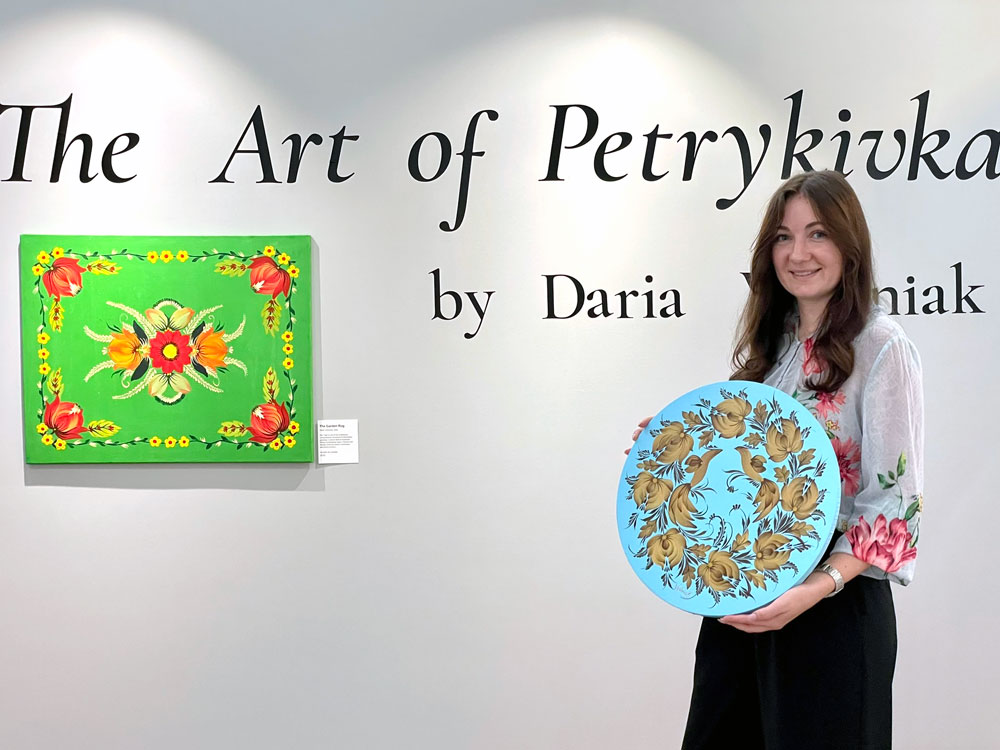
What We Bring With Us: Ukrainian immigrant Daria Vyshniak brings her love of Petrykivka painting to the U.S.
FOUNDING VOICES
Daria Vyshniak
This story was shaped by a conversation between Daria and an Immigrant Hall of Honor storyteller.
|
From |
Ukraine |
|---|---|
|
Arrived in the U.S. |
2023 |
|
Occupation(s) |
Artist, Retail |
By the time Daria Vyshniak picked up a paintbrush in 2022, she’d already fled a war-torn Ukraine, crossing the border into Poland.
“I was struggling with anxiety and depression, and in this moment, Petrykivka painting came into my life,” Vyshniak told the Immigrant Hall of Honor.
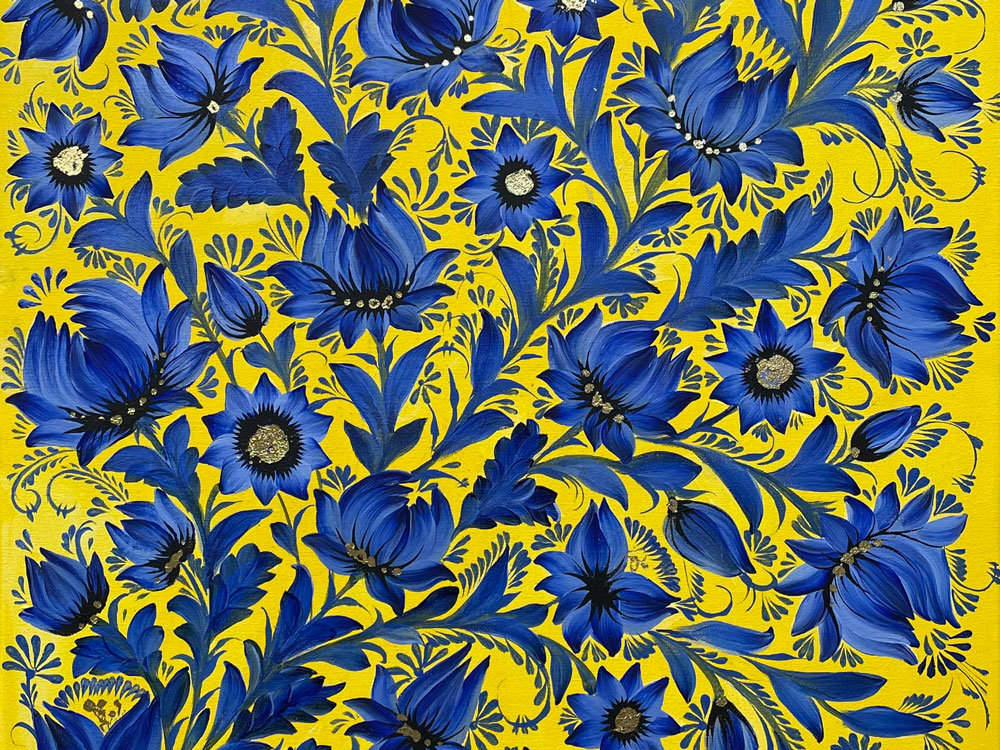
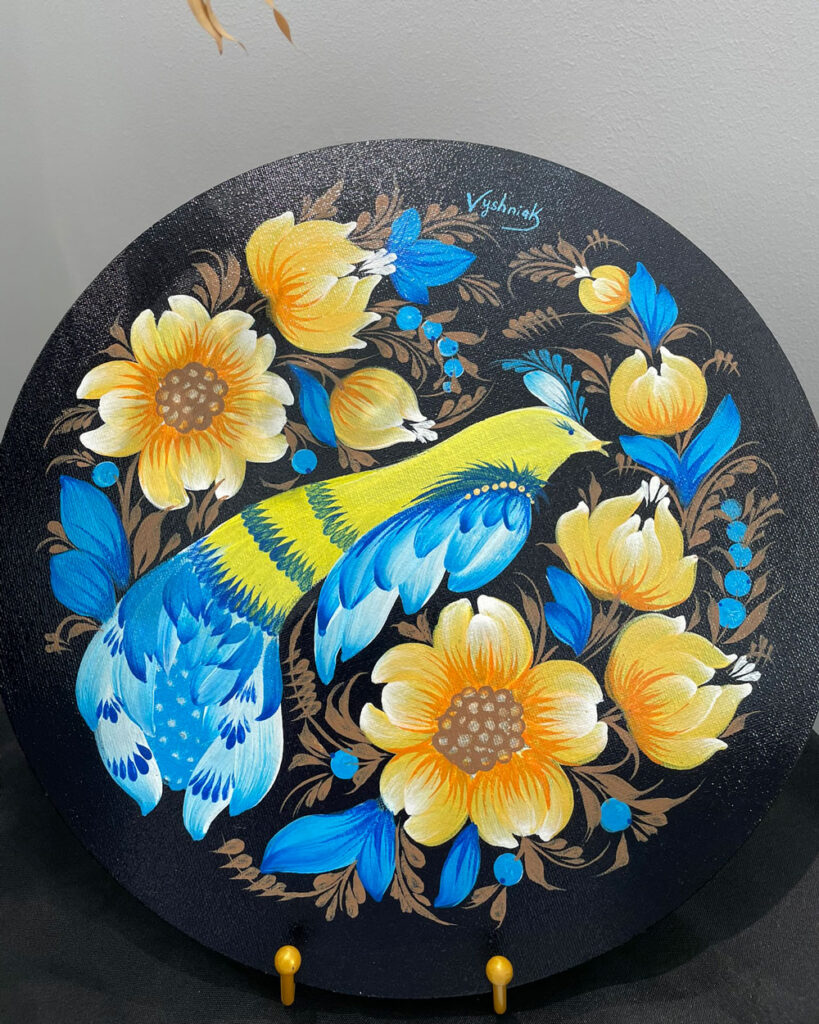
The traditional Ukrainian decorative art form originated in the village of Petrykivka over 200 years ago. UNESCO recognized it as an Intangible Cultural Heritage of Humanity in 2013. Traditionally used to decorate homes and household objects, Petrykivka painting is known for its vibrant flowers, leaves, berries, and birds—images drawn from nature and transformed into elaborate, fantastical designs.
In folk belief, the paintings protect people from sorrow and evil. For Vyshniak, that centuries-old belief took on new meaning, as she painted to cope with war, displacement, and uncertainty.
Video: © 2013 Promysel, via UNESCO
The War Hits Home
When Russia launched its full-scale invasion of Ukraine on February 24, 2022, the war quickly reached cities and towns across the country. For Ukrainians living in areas near the fighting, the invasion meant artillery and rocket fire, damaged and destroyed homes, and days or weeks spent sheltering from attacks. In the first month of the invasion, the United Nations documented thousands of civilian casualties and damage to hundreds of homes, hospitals, schools, kindergartens, and other civilian sites.
In areas occupied by Russian forces, civilians faced additional dangers. The United Nations documented killings, arbitrary detention, disappearances, and other serious violations of international humanitarian and human rights law. In some communities, residents sheltered underground for weeks, treated wounded neighbors with limited medical supplies and buried the dead in improvised graves when fighting made normal burials impossible.
Crossing into Poland
As the Russians moved in, Vyshniak joined millions of Ukrainians fleeing west. Poland, Hungary, Moldova, Romania, and Slovakia all opened their borders to people seeking safety.
More than 2 million Ukrainians crossed into Poland during the first three weeks of the invasion. Some traveled for days, through areas affected by fighting, before reaching the border. Others waited in freezing temperatures for hours—in some cases as long as 60 hours—to cross.
The Polish government welcomed Ukrainians with food, medical, and psychological assistance, free public transportation, and help finding a place to stay. But the response went far beyond government services. Across Poland, ordinary families opened their homes to people fleeing the war, hosting an estimated hundreds of thousands of Ukrainian refugees.
Here, Vyshniak met another Ukranian refugee—an artist teaching Petrykivka painting at the local library.
Vyshniak had been exposed to this very Ukrainian style of painting her entire life.
“Everywhere we use this style,” she explains.
She remembers seeing Petrykivka motifs in television advertising around Eurovision 2017, when Ukraine hosted the international song contest in Kyiv. Still, she didn’t try Petrykivka painting herself until she discovered this class in Poland.
She has since grown to love the art form, from the cat-hair brush that allows the thin, delicate strokes of paint to the sense of calm that it brings her in turbulent times.
Uniting for Ukraine
In 2023, Vyshniak and her husband came to the United States through Uniting for Ukraine, a humanitarian parole program created for Ukrainians displaced by the war.
Under U4U, eligible Ukrainians and their immediate family members could request permission to travel to the United States after being supported by a U.S.-based individual or organization. Those granted humanitarian parole were generally permitted to remain in the country temporarily, while pursuing work and building their lives.
A pastor from a United Methodist church agreed to serve as the couple’s U.S. supporter. In their case, that support meant helping them establish a place to live: a member of the pastor’s congregation hosted the couple for their first six months in the United States.
During that time, they found jobs, looked for a home of their own and began building a life in a new country.
By September 2024, the Department of Homeland Security had granted humanitarian parole to more than 230,000 Ukrainians and eligible family members through U4U.
But humanitarian parole is temporary. The program gave Ukrainians displaced by the war a way to come to the United States and establish themselves, but it did not itself provide permanent immigration status.
For Vyshniak, that uncertainty is part of life in the United States. She and her husband love their new home, she says, but they don’t know what their long-term future will look like. With her hometown still under Russian control, returning home is not an option she considers safe.
Carrying Culture Forward
When IHH interviewed Vyshniak for this story, a collection of her Petrykivka paintings was on display in a public library.
Beside the paintings was a one-page explanation of the tradition. Each artwork was accompanied by a thoughtful label describing the symbolism of its colors and subjects.
“I just want to share this part of my Ukrainian culture with people,” Vyshniak said.
“Petrykivka isn’t just flowers, birds and roosters. Everything has symbolism. Everything has meaning.”
Birds, she explained, symbolize hope and freedom.
“I like freedom very much, and Ukraine does too—that’s why we paint birds everywhere.”
The rooster represents home. Easter eggs are another traditional subject. And some of the flowers and birds in Petrykivka don’t exist in the natural world at all.
“We paint non-existent flowers and birds—the most beautiful things we can imagine.”
That may be what makes Petrykivka such a fitting art form for Vyshniak’s story.
For Vyshniak, Petrykivka painting holds the power to bring something bright and light into dark times.
If there is one thing she’d like people to take away from her story, it is this:
“Never give up. Even in dark times, there is always something light and bright. And there is always next year.”
Inspired by this Story?
Discover more inspiring immigrant stories and learn how immigrants have shaped American history. Subscribe to the Immigrant Hall of Honor’s monthly e-newsletter.
Monthly stories and updates from the Immigrant Hall of Honor. Unsubscribe at any time.