
Immigrant Hall of Honor Expands Storytelling Resources for Genealogists, Second-Generation Immigrants and More
New storytelling pathways make it easier for people to document their own immigration experiences, preserve a family member’s story, research an immigrant ancestor, or share a story in their own words.
The Immigrant Hall of Honor has expanded its storytelling resources with new pathways designed to help more people preserve and share the immigration stories that connect their families to American history.
The new resources are part of IHH’s ongoing effort to make storytelling more accessible—not only to experienced writers and genealogists, but to anyone who has a story to tell and may not know where to begin.
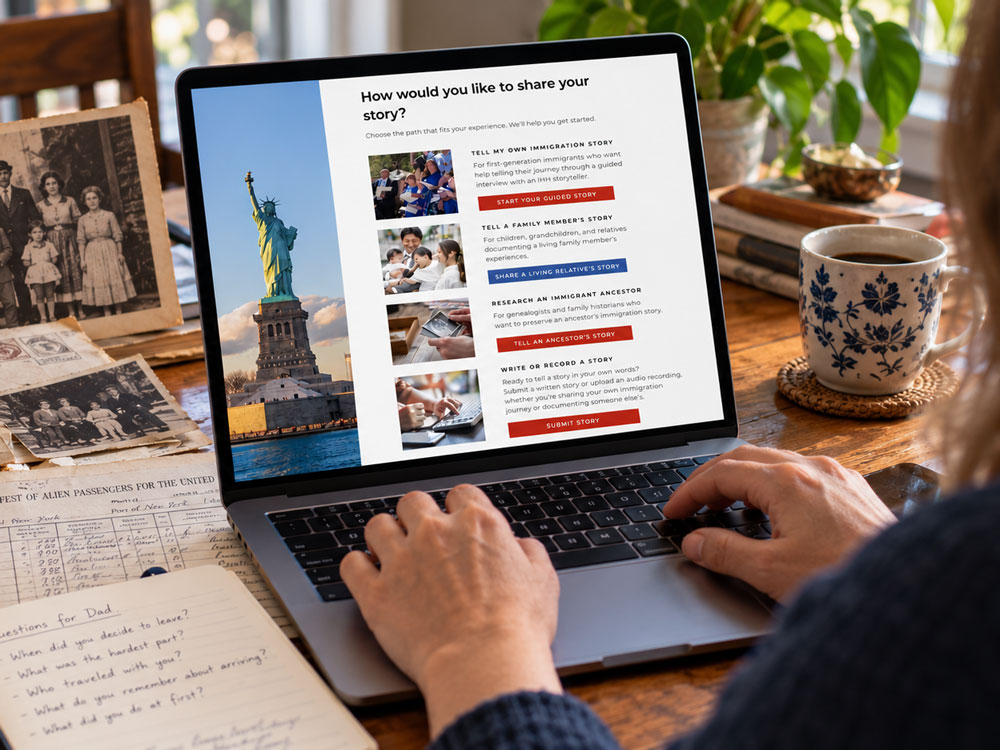
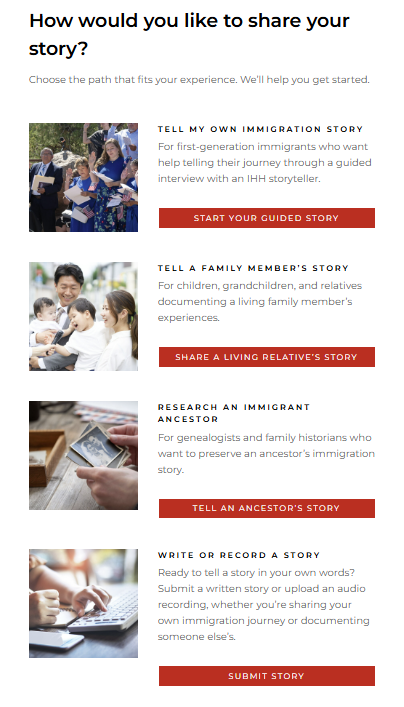
Visitors to IHH’s Tell Your Story webpage can now choose from four storytelling pathways based on their circumstances and the kind of story they want to tell.
Tell My Own Immigration Story
The Tell My Own Immigration Story pathway is designed for first-generation immigrants who want to document their own experiences.
The guided oral history form asks 10 questions about the immigrant’s journey, including what brought them to the United States, what they remember about arriving, challenges they encountered, accomplishments they are proud of, traditions they have maintained, and what they hope for the future.
Participants can type their answers directly into the form or record their responses and upload them as audio files. This option is particularly valuable for people who may feel more comfortable telling their story aloud than writing it down, including immigrants for whom English is a second language.
Participants do not have to write their own finished story. After receiving a submission, an IHH storyteller reviews the responses and uses them to craft a narrative draft. The storyteller’s job is not simply to transcribe the participant’s answers, but to identify the story’s central thread, organize the material into a compelling narrative, and, when appropriate, provide historical or cultural context for readers.
The participant then has an opportunity to review the draft before it is published. This step is especially important when a story crosses languages and cultures. Participants can clarify the meaning of words or expressions, correct misunderstandings, add cultural context, identify details that do not accurately reflect their experience, and request changes to the way their story is presented.
The person who lived the story remains the final authority on how that story is told. IHH’s role is to help make the story accessible and engaging for a broad audience while preserving the immigrant’s own perspective, experiences, and voice.
The resource was introduced earlier this year as IHH’s first guided storytelling pathway for contemporary immigrants. It reflects IHH’s larger goal of making professional storytelling support available to people who have important stories to share but may not have the time, confidence, writing experience, or English-language fluency to write a finished narrative themselves.
Tell a Family Member’s Story
The new Tell a Family Member’s Story pathway is designed primarily for second-generation immigrants who want to document the immigration experience of a parent or other living relative.
Many second-generation Americans grow up knowing that a parent or other relative immigrated to the United States, but may know only the broad outlines of that experience. They may know where their parent was born, when they arrived, or what country they left behind without knowing what it was actually like to leave home, arrive in a new country, learn a new language, build a career, raise a family, or maintain cultural traditions in the United States.
The new resource provides a guided set of interview questions to help family members have those conversations.
Questions explore the relative’s life before immigration, what led them to leave their home country, their journey to the United States, their first experiences after arriving, challenges they encountered, accomplishments they are proud of, traditions they have maintained, and the ways their immigration experience has shaped their family.
Participants can conduct the interview in whatever format works best for their family. They can record their relative’s responses or type them into the online form, allowing the conversation itself to become the foundation for the story.
As with the “Tell My Own Immigration Story” pathway, participants do not have to write the finished story themselves. After receiving the interview responses, an IHH storyteller reviews the material and crafts a narrative draft.
Because this pathway involves telling the story of another living person, both people involved in the process have an opportunity to review the draft before publication. The immigrant who lived the story can verify their experiences, clarify details, explain cultural references or expressions, and request changes to ensure the story accurately reflects their perspective. The family member who conducted the interview can also review the draft, add or correct family context, and identify details that may have been misunderstood or left out before publication.
Research an Immigrant Ancestor
The new Research an Immigrant Ancestor pathway is designed for anyone who wants to learn more about an immigrant ancestor—not just experienced genealogists or family historians.
Many people know that an ancestor immigrated to the United States but have little idea how to begin researching that person’s life. Others may have a name, an approximate date of arrival, or a few family stories but don’t know what historical records are available or where to find them.
This resource provides a starting point.
IHH walks participants through a series of research questions designed to help them discover information about their ancestor’s life before, during, and after immigration. The questions encourage participants to investigate their ancestor’s origins, journey to the United States, first experiences in the country, work, family and community life, and the traditions and cultural practices they may have carried with them.
For those who want more detailed guidance on which records to look for and what those records can reveal, the pathway links directly to Part 3 of IHH’s free Beginner’s Guide to Telling Your Family’s American Immigration Story, which provides a deeper introduction to researching an immigrant ancestor. Part 3 explains how to use sources such as census records, passenger manifests, naturalization records, military records, newspaper articles, city directories, obituaries and other historical documents to piece together an ancestor’s life.
The new pathway also links to three examples of completed IHH immigrant stories, giving participants an opportunity to see how research can be transformed into a compelling narrative about a real person’s immigration experience.
As with the “Tell My Own Immigration Story” and “Tell a Family Member’s Story” pathways, participants don’t have to write the entire story themselves.
After completing their research, they can type or record their answers to the research questions and submit them through a new online form. An IHH storyteller then reviews the responses and uses the information provided to assemble a story draft.
The participant remains an important part of this process. They review the draft, provide additional information, correct inaccuracies, and request changes before the story is published.
That review is particularly important when working with historical records. Genealogical research can involve incomplete records, inconsistent spellings, changed names, conflicting dates, and other gaps in the historical record. It is also possible to find two or more people with the same or similar names living in the same place at the same time. Without additional family knowledge, it can be difficult to determine which records actually belong to a particular ancestor.
The participant may recognize details that a researcher could not—such as a relative’s nickname, occupation, spouse’s name, place of residence, or family relationship—and can help distinguish their ancestor from someone else with a similar identity. Their knowledge provides an important layer of verification that historical records alone may not provide.
The goal is not simply to assemble a collection of documents, but to use those documents to tell the story of a real person. By combining historical research with the family’s own knowledge, IHH hopes to create stories that are both engaging and as accurate as the surviving evidence allows.
Write or Record a Story
Not every storyteller needs or wants a questionnaire.
For people who already know what they want to say—or simply want to tell their story in their own way—IHH continues to offer its freeform story submission, which the organization refers to as its “blank canvas” approach.
Participants can write or record an immigration story without following a prescribed set of questions. They can begin wherever they feel comfortable and tell the story in their own words.
Like the other three pathways, the freeform submission now accepts audio files, making it possible for participants to dictate their stories rather than write them.
More Pathways Are Coming
IHH plans to continue expanding its storytelling resources. Before the end of 2026, the organization hopes to add a fifth pathway for people who want to preserve and share the immigration story of a recently deceased family member.
The new resources are part of IHH’s larger effort to document the many different ways immigration has shaped American families and communities.
Whether someone is an immigrant telling their own story, a second-generation American documenting a parent’s experience, a genealogist researching an ancestor, or simply someone who wants to put their family’s story into words, IHH’s goal is to make sure there is a place to begin.
Stay Up to Date with IHH
Get the latest news, inspiring immigrant stories, and updates from the Immigrant Hall of Honor delivered straight to your inbox.
Monthly stories and updates from the Immigrant Hall of Honor. Unsubscribe at any time.