
How immigrants powered new york’s garment industry
Long before New York became a global fashion capital, it was something else: a city where immigrants made clothes. The garment industry that helped transform New York’s economy and eventually gave the city its reputation as a fashion capital, was built by generations of immigrants.
An industry takes shape
New York’s clothing industry was already developing before the great waves of immigration from Southern and Eastern Europe began in the late 19th century.
The city’s position as a major port and commercial center gave manufacturers access to textiles, markets and a growing workforce. By the 1830s, New York was producing ready-made clothing, and the invention and spread of the sewing machine dramatically accelerated production. During the Civil War, enormous demand for military uniforms helped propel the industry into mass production.
As the industry grew, so did its need for workers.
And New York had them.
The immigrant workforce
The garment industry was never the work of a single immigrant group.
Irish immigrants played an important role in the trade during the mid-19th century. Germans were also prominent in the industry’s earlier development. By the late 19th and early 20th centuries, Italians and immigrants from Eastern Europe—including hundreds of thousands of Jews from the Russian Empire—had become central to New York’s clothing industry.
The pattern was part of a larger story of immigration: newcomers entered industries where their skills could be put to work, established communities around those workplaces and gradually built economic footholds in their new country.
For many immigrants, the garment trade offered one of the more accessible paths into wage work.
Why Jewish immigrants became so prominent
Eastern European Jewish immigrants had a particularly strong presence in the clothing trades.
In parts of the Russian Empire, Jews faced restrictions on where they could live and the occupations they could pursue. Tailoring, sewing, textile work and small-scale commerce became important occupations within many Jewish communities.
Those skills traveled with immigrants to America.
Around the time of the great migration, an estimated 250,000 people—approximately one-sixth of Russia’s Jewish workforce—were involved in clothing manufacturing. When these immigrants arrived in New York, they entered an industry that already needed workers and possessed skills that translated readily to American garment production.
But Jewish immigrants were not alone. Italian immigrants became another major presence in the needle trades, and the industry continued to absorb newcomers from many parts of the world.
From the home to the factory
Clothing production in New York did not initially look like the modern factory system.
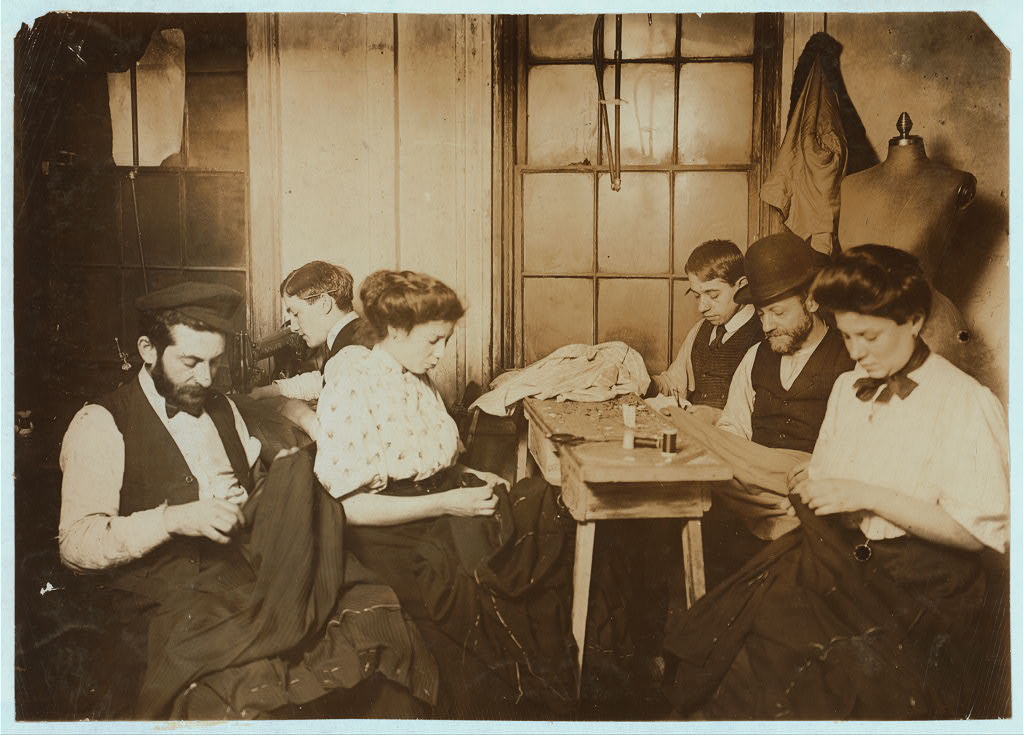
Garments could be made in factories, small workshops or even inside workers’ homes. Manufacturers frequently relied on contractors to distribute work to smaller shops or individual workers.
This system created a complicated network of production.
A worker might cut fabric, operate a sewing machine, press garments or finish seams. A contractor—sometimes called a “sweater”—could receive work from a manufacturer and distribute it among workers.
For immigrant families, the home itself could become a workplace. Entire families might participate in production, often working long hours for relatively low wages.
The system created opportunity, but it could also be exploitative and dangerous. Crowded workshops, poor ventilation, long hours and inadequate safety protections were common.
Women at the sewing machine
Women were especially important to the growth of the garment industry.
For immigrant women with limited English and little formal education, sewing-machine operation could provide a way to earn wages outside domestic service. The work was repetitive and often poorly paid, but the skills could be learned relatively quickly.
By the beginning of the 20th century, immigrant women made up a substantial portion of New York’s garment workforce.
Their labor was essential, but so was their willingness to challenge the conditions under which they worked.
Immigrant women organize
The garment industry became one of the most important arenas of early 20th-century labor activism.
In 1909, thousands of mostly immigrant women garment workers went on strike in what became known as the Uprising of the 20,000. The strike was part of a growing movement for higher wages, shorter hours, safer workplaces and greater control over working conditions.
Two years later, the Triangle Shirtwaist Factory fire killed 146 workers, many of them young immigrant women.
The tragedy shocked New York and the nation. Public outrage helped generate political pressure for stronger fire codes, workplace regulations and labor protections.
Immigrant garment workers were not simply passive participants in New York’s industrial economy.
They helped reshape it.
The industry moves uptown
As the clothing trade expanded, manufacturers gradually moved north from the Lower East Side and other immigrant neighborhoods.
By the early 20th century, garment production was concentrating in Midtown Manhattan. The area that became known as the Garment District developed into a dense network of factories, showrooms, suppliers and businesses serving the clothing trade.
That concentration was enormously important.
Manufacturers could be close to textile suppliers. Designers could work near manufacturers. Buyers could visit showrooms. Workers could move between jobs. Businesses that supported the industry—from button and zipper suppliers to pattern makers and shipping companies—clustered nearby.
The neighborhood became an industrial ecosystem.
By 1931, the Garment District had the world’s largest concentration of clothing manufacturers.
From manufacturing center to fashion capital
This is where New York’s immigrant garment history connects directly to the fashion capital we know today.
Manufacturing created more than factories. It created infrastructure for fashion.
A city with skilled garment workers, manufacturers, textile suppliers, wholesalers, department stores and buyers already had much of what designers needed to turn ideas into finished clothing.
New York’s fashion industry grew from this foundation.
World War II accelerated the process. As the war disrupted Europe’s fashion industry, particularly in Paris, New York designers and manufacturers gained new opportunities to establish the city as a major center of fashion design and production.
New institutions emerged to strengthen the industry. The New York Dress Institute promoted American fashion. In 1944, the Fashion Institute of Technology was founded to educate people for careers in the fashion and design industries.
The city’s garment industry was becoming something larger than manufacturing.
It was becoming fashion.
The legacy of immigrant labor
Today, much of New York’s clothing manufacturing has moved elsewhere. The Garment District is no longer the manufacturing powerhouse it was a century ago.
But its legacy remains.
New York continues to be one of the world’s great fashion capitals, and the industry still depends on the skills of people from around the world.
Fashion begins long before the runway; it begins with people who know how to turn fabric into clothing. And for generations, many of those people were immigrants. They came from Ireland, Germany, Italy, Russia, Eastern Europe, China, Korea, Puerto Rico, Latin America and countless other places, bringing skills, creativity and entrepreneurship with them. They did more than make clothes. They helped establish New York as a fashion capital.
Sources & Further Reading
Explore the history behind New York’s garment industry and the immigrant communities who helped build it.
Garment District NYC
A Stitch in Time: A History of New York’s Fashion District
Explore the history of New York’s garment industry, from its early beginnings and immigrant workforce to the development of the Garment District and New York’s emergence as a fashion capital.
Museum of the City of New York
Garment Workers: Upheaval in the Garment Trades, 1900–1915
Learn about the immigrant workers who powered New York’s garment industry and the labor activism that culminated in the Uprising of the 20,000 and helped bring attention to working conditions in the city’s clothing trades.
My Jewish Learning
Jewish Immigrants in the Garment Industry
Discover how Jewish immigrants from Eastern Europe became an important part of New York’s clothing industry, bringing skills and traditions that shaped the city’s garment trades.
New York State Department of Labor
Triangle Shirtwaist Factory: Born From Fire!
Learn how the 1911 Triangle Shirtwaist Factory fire, which killed 146 workers—many of them young immigrant women—helped spur changes to workplace safety and labor regulations in New York.
Museum of the City of New York
Triangle Shirtwaist Factory Fire
Explore the history of the Triangle Shirtwaist Factory fire and the lives of the workers who were killed, as well as its lasting impact on New York’s labor movement and workplace safety.